01
Give Oqera the goal
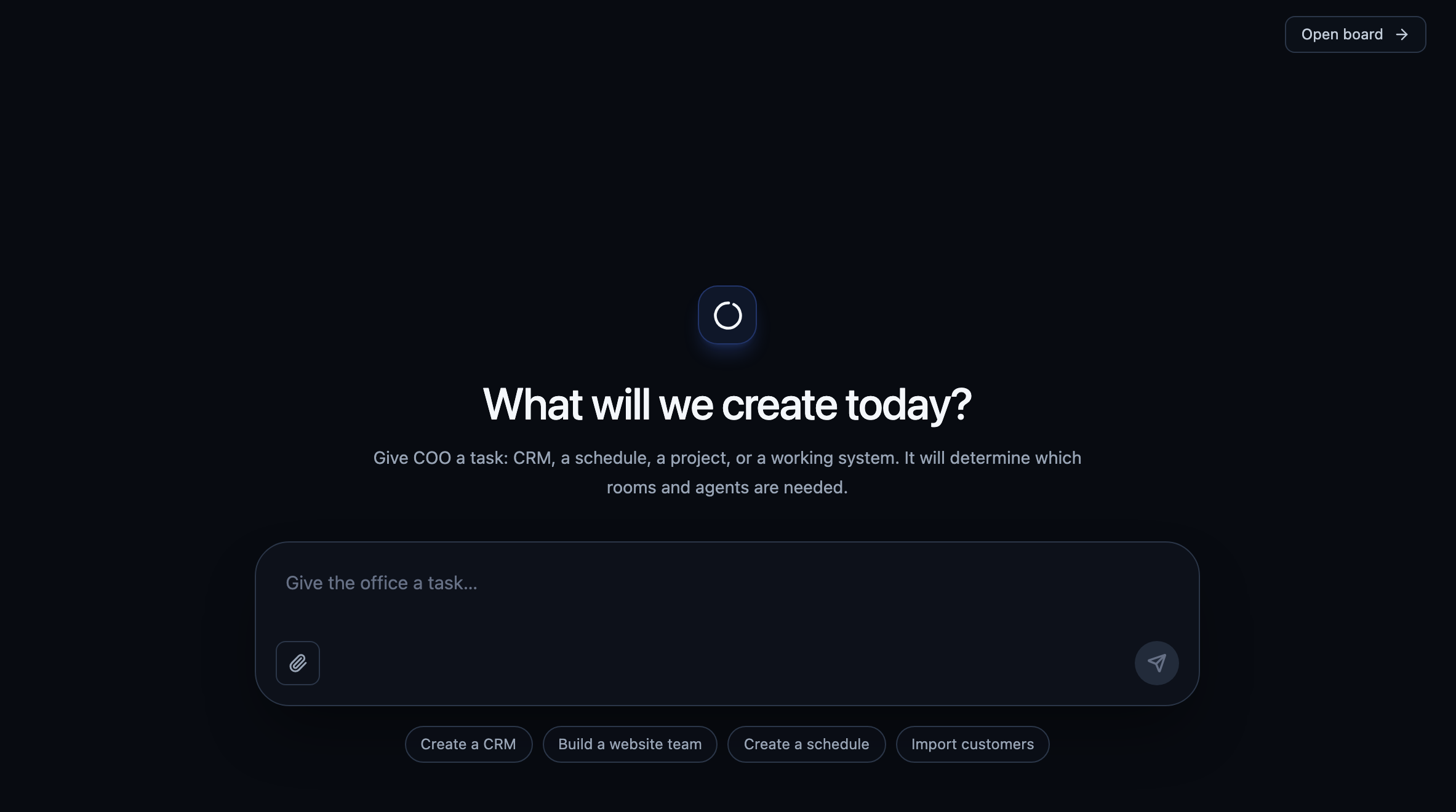
In plain language, in one place. No prompt engineering, no graph to draw first. The COO asks what it still needs to know, then decides which rooms are involved.
COO→ Teams→ Managers→ AI specialists
Give Oqera one business task. It decides which teams are needed, splits the work between managers and AI specialists, and brings the result together in one place.
The actual problem
The models are good enough. What is missing is the org chart around them: who does what, who checks it, and where the context lives between Tuesday and Friday.
Next week the context is gone and you rebuild the whole chain from scratch.
Next week the rooms still remember the business. You state the next task, not the whole backstory.
How it works
One rule borrowed from real companies makes it work: a worker never hands work to another worker. Control returns to a manager, who decides what happens next — which is also where you step in.
In plain language, in one place. No prompt engineering, no graph to draw first. The COO asks what it still needs to know, then decides which rooms are involved.
Each room manager splits the goal into tasks for its named specialists, in a fixed order, running side by side wherever nothing depends. Control comes back to the manager after every task.
Not a summary of a chat: a typed artefact with its evidence, its uncertainty and the trail behind it. What the rooms learn stays, so the next task does not start from a blank page.
Specialized Rooms
These are productized Room candidates in the current codebase. None is presented as Release A available until its complete Room-specific gate and the shared platform gate both pass and the canonical production allowlist is updated.
Tracks competitors, market changes and customer signals with evidence traceability.
Independent Market VerifierTurns customer evidence and product context into traceable decisions and briefs.
4 agentsMoves from evidence and founder voice to reviewed channel-ready drafts.
4 agentsOne hard decision in, a decision-ready brief out: framing, real options, an independent stress test, a synthesis.
4 agentsInterviews and customer signals become evidence you can trace, hypotheses that are testable, and the next research step.
3 agentsKeeps founder-led opportunity context, evidence and the next reviewed action together.
3 agentsDiagnoses funnel and experiment quality before recommending the next bounded action.
3 agentsNo first-session wedge has been selected. Decision Sprint, Customer Discovery, Market → Content and Product Decision remain options for a separate product decision after release gates pass.
The honest comparison
Use them. Oqera runs on them — you connect your own provider key, so it is literally the same models. The difference is not intelligence. It is who owns the workflow around it.
Great models. Every time you use one, you still:
Use the models you already like. Stop coordinating the work around them:
Same models. Different operating structure.
Under it
None of the above survives contact with real work without these. They are the reason a room still behaves the same on its fortieth run.
Your business canon — positioning, glossary, policies, process — is stored exactly and read exactly, never retrieved as "one of the top three similar chunks". Agents read it. Only you change it.
Click into any agent and see the live stream of what it reads, runs and writes. When something goes wrong you can see where, instead of guessing at a bad final answer.
An agent never calls another agent. Control returns to the room manager every time, so a fix-and-recheck loop is structural, and you always have one place to step in and change the task.
Routes that change your business state stop at Human review required and wait. You Approve, Request changes, Reject or Defer, with a comment — and the decision is recorded. A dangerous tool call can be paused for you too.
Draw a dependency and work waits for it. Draw none and the agents run at the same time, each in its own isolated session. You are not queueing behind a single chat.
Start a room on a schedule, an incoming webhook, or a status change on the board. The Monday morning report exists on Monday morning, whether or not you opened the app.
Pricing
Bring your own key
Release A does not include managed model credits. During assisted onboarding you connect your own supported provider key, and that provider bills model usage directly. Oqera never needs your key in analytics, support notes or marketing forms.
$0during Release A
Invite-only access for 5–10 partners, with a 30–45 minute assisted setup.
Bring your own AI provider key. Model usage is billed by your provider, not by us.
Release gate pending—not on sale
Self-service pricing, checkout and the broader Room catalog are not available in the design-partner beta.
Bring your own AI provider key. Model usage is billed by your provider, not by us.
Not available in Release AOqera contains multiple real multi-agent Room implementations. The strict current-worktree shared release gate is not complete, so the canonical Release A allowlist is currently empty. Candidate Rooms will be promoted individually after both Room-specific and shared gates pass.
So: no invented logos on this page, no customer counts, no uptime promise we have not earned. If you need an enterprise SLA today, Oqera is not it yet. If you want to shape a tool while it is still shapeable, this is the good moment.
Questions
No — it runs on them. You connect your own provider key, so the models doing the work are the ones you already chose. Oqera is the structure around them: named specialists, a fixed order of work, an independent reviewer, a shared task board, and memory that survives the conversation.
A Custom GPT is one worker with an instruction. Oqera is the organisation many of them work inside. Keep using a chat window for quick questions — that is not the work Oqera is for.
The current codebase contains several specialized Rooms, including Market, Product Decisions, Content Engine, Decision Sprint, Customer Discovery, Founder Sales and Growth Lab. The canonical Release A catalog is currently empty because the shared release gate has not passed.
Implementation presence is not availability. A Room appears in Release A only after its complete product path, Room-specific evidence, shared platform evidence and production allowlist entry are all verified.
No. You never write code, and you never draw a workflow graph before getting a result. You should be comfortable with ChatGPT or Claude and willing to paste an API key by following a short guide. If you have never used an AI tool before, Oqera is the wrong first step.
Yes to the key, no to the usage — and the alternative is worse for you. A platform that bundles tokens has to pad the price to survive the heaviest users, and then cap you when you become one. Oqera charges for the platform and stays out of your model bill entirely.
It also means you choose the model and provider. Release A has no managed model-credit trial, so a working supported provider key is required during assisted onboarding.
Release A is designed as a free invite-only assisted beta for 5–10 design partners with a required BYO provider key. Room access opens only after strict engineering gates; no Room is currently advertised as Release A available. Public self-service signup and checkout are Release B work.
They are deterministic automation: you specify every step, and they execute exactly that. They are excellent at it, and if your work fits that shape you should use them. Oqera is for work where the steps depend on what is found along the way — research, analysis, judgement, drafting, critique — and where somebody has to check the result before it counts.
Not by us. Your canon, task board and room memory are your data, and Oqera does not train on them. Whatever your agents send to your AI provider is governed by that provider's terms — another reason you hold the key and can pick a provider whose policy you accept, or run a model locally.
You see it. Failures land on the board with the error, not swallowed into a confident-sounding answer, and you can open the agent's live stream to see the exact call that broke. Because control returns to the room manager after every task, a redo is a normal part of the loop rather than starting the whole thing again.
That is the direction the architecture is built for, and it is how Oqera is developed day to day. It is not a one-click self-serve install yet — if this is what you specifically need, write to us and say so, because it moves the priority.
Anyone who wants a single chatbot on their website, a deterministic if-this-then-that automation, or an enterprise rollout with procurement and an SLA. Also anyone perfectly happy with one ChatGPT project — if that covers your work, keep it.
Cancelling, refunds and how billing works are on the pricing page.
Release A is planned as a small invite-only beta with assisted onboarding and your own model-provider key. Room access opens after the engineering release gate.